When choosing water for an ultrasonic humidifier, check whether your exact model allows it and whether its mineral content has been reduced. You will also need a routine for emptying and cleaning the unit. Read the manual alongside the water label, and think about whether you can keep up with the care it needs.
Plan both which water to use and when to replace it
Ultrasonic humidifiers can disperse minerals and microorganisms from tank water into indoor air. Water selection and cleaning therefore both matter. US EPA humidifier guidance
If the manual prohibits a type of water, do not add it solely because a general article recommends it. Ask the manufacturer:
Can this exact model use distilled or demineralized water? If not, which water is permitted, and what maintenance does it require?
If the answer is unclear, pause use rather than mixing waters or experimenting. If general advice about reducing minerals conflicts with the model's water requirements, ask the manufacturer to clarify both before using it.
Use the manual for the model sold in your region. The US consumer guidance cited here does not verify every regional model or the water available at your address.
Look at treatment and labeling, not only the water's name
| Water description | What to check |
|---|---|
| Tap water | Whether the model allows it and what mineral-related care it requires |
| Water from a household filter | The filter model, treatment method, and whether it removes minerals |
| Bottled drinking water | Whether any mineral-removal treatment is actually stated |
| Distilled or demineralized water | Label, intended use, and compatibility with the humidifier's requirements |
EPA advises considering low-mineral water, including distilled water. Water being bottled does not mean its minerals have been removed. Check the treatment method, such as distillation or reverse osmosis. EPA water-selection guidance
Before buying new water, find your existing filter's model and treatment information. If you cannot find the treatment method, note “treatment unconfirmed.” The word “filtered” alone does not tell you whether the water is suitable.
Begin the daily routine by emptying, not topping up
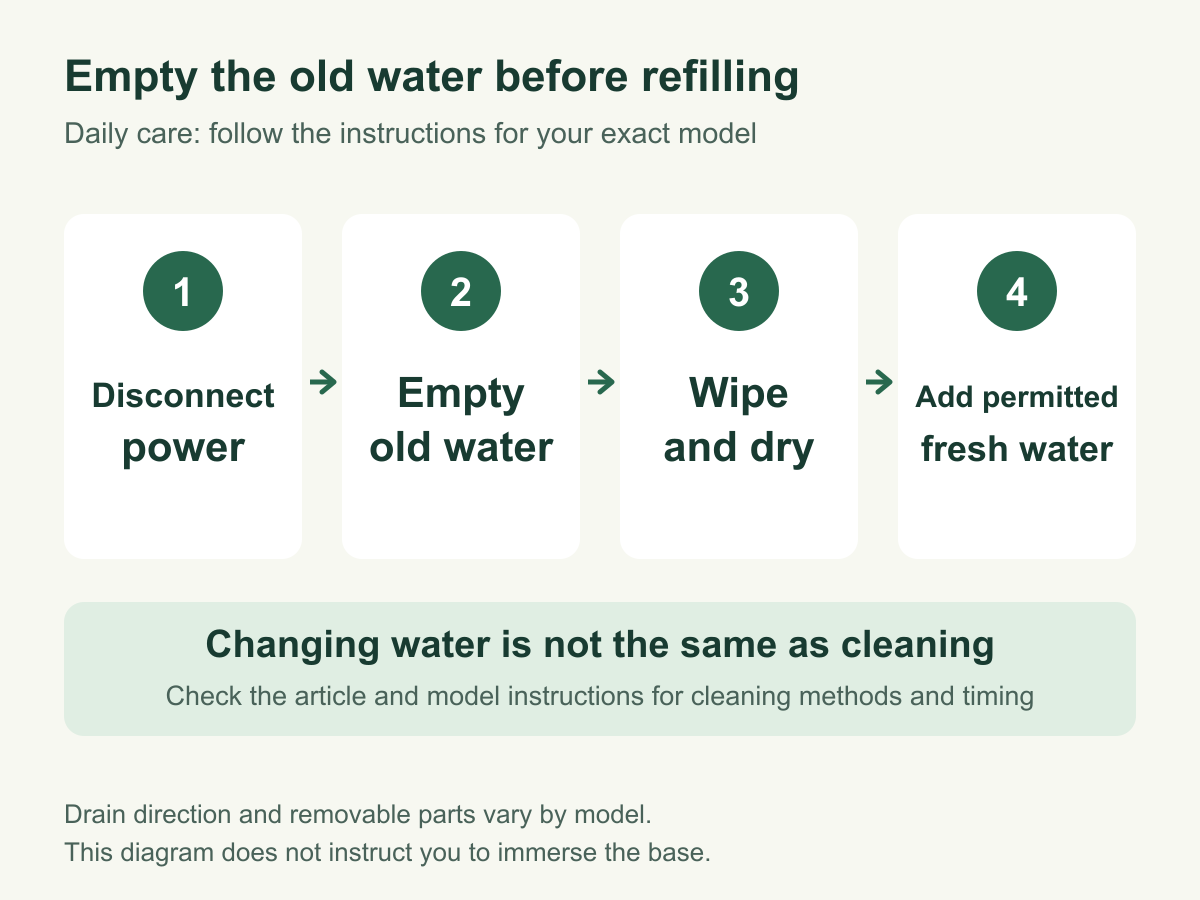
The US CPSC advises emptying the tank before refilling and changing water daily if possible. It also advises unplugging before cleaning, following the manufacturer's method, and thoroughly rinsing out cleaning products. CPSC humidifier care guidance
Follow the manual as you work through these steps:
- Stop operation and disconnect power as instructed.
- Empty the remaining water, checking the specified draining direction.
- Check the parts that touch water, then wipe and dry them using a method the manual allows.
- Refill with fresh, compatible water when you next use the unit.
Check whether water remains beneath a removable tank. Do not immerse the whole powered body or dismantle parts that the manual does not identify for user maintenance. If you see contamination in a place you cannot reach for cleaning, ask the manufacturer what to do.
For portable humidifiers, EPA distinguishes daily water replacement and drying from cleaning every third day. Check whether the manual calls for more frequent care. EPA maintenance intervals
Do not improvise cleaning-agent concentrations or mix chemicals. Cleaning residues matter in an appliance that disperses mist. Likewise, check whether a fragrance or additive is explicitly permitted in that water tank before using it.
What should you do about white dust or deposits?
White dust alone cannot tell you whether there is a serious health risk, and it should not be assumed harmless either. CPSC says its health effects are uncertain and depend on the types and amounts of minerals in the water. CPSC explanation of humidifier dust
Rather than trying to identify the deposit yourself, note where it appears, which water you used, the model number, and when you last cleaned the unit. Take a photograph too, so you can show the manufacturer what you are seeing. Follow the manufacturer's care method rather than allowing film or deposits to accumulate.
Check whether adding humidity is still needed
EPA advises against humidifying above 50% indoor relative humidity. Reduce output or use when condensation or nearby dampness occurs. If respiratory symptoms seem associated with humidifier use, stop using it and contact a clinician. EPA humidity and symptom precautions
If your humidity meter is beside the humidifier, review the instructions for measurement and placement. If the area around the humidifier is getting wet, do not keep running it just to reach a target humidity reading.
Postpone a new purchase if the room is already humid or windows and walls are collecting condensation. A larger tank will not remove the need to make time for daily care.
Check how easy it will be to empty and clean
Add the questions below to your notes on mist output and tank capacity. They can also help you decide whether you can comfortably keep caring for the humidifier you already have.
| Action | Question to answer |
|---|---|
| Empty remaining water | Can you carry the parts and drain them in the specified direction? |
| Wipe water-contact areas | Can your hand or the permitted tool reach the designated areas? |
| Dry parts | Which parts may be removed, and where will you leave them? |
| Refill | Can you regularly obtain water that meets the model's requirements? |
| Replace supplies | Do you know the part numbers, replacement conditions, and local source? |
You can also estimate what it will cost to keep a supply of suitable water. Suppose you use 1.5 L per day for 30 days:
1.5 × 30 = 45 L
This amount is just an example for planning. It is not measured mist output or an amount of humidification you are required to use. Multiply by the verified price per liter of compatible water available to you. Water discarded during care and delivery charges are additional considerations.
Our appliance buying checklist covers model identification and maintenance requirements. Once water compatibility is clear, choose a time to empty the remaining water and a place to dry the permitted parts. Make sure both fit into your day before choosing a unit you plan to use regularly.
Sources checked: September 8, 2026. AI assisted drafting and English localization from our Korean article. This is general EPA and CPSC consumer guidance, not a model-compatibility test or an assessment of an individual's respiratory symptoms.