A low-heat cycle does not make a garment labelled “do not tumble dry” suitable for the dryer. First check whether tumble drying is allowed. Only then choose a machine setting that meets the garment’s heat instructions. A gentle-sounding cycle name cannot override the care label.

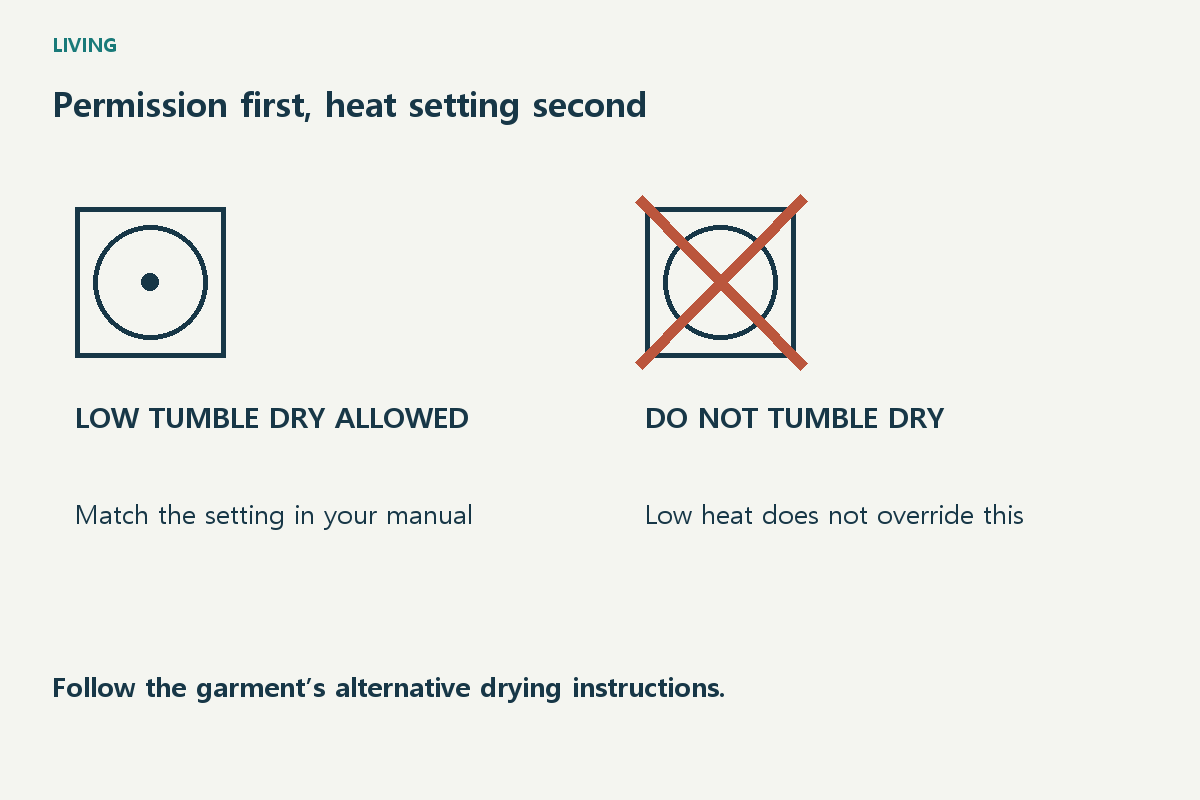
Start with the tumble-drying symbol
The tumble-drying symbol is generally a circle inside a square; a cross through it means do not tumble dry. Dots indicate heat settings, which should be interpreted with the label system and product guidance. Whirlpool laundry-symbol guide
If the label is faded, do not substitute the instructions from a similar-looking garment. Lining, trims and prints can change how an item needs to be cared for. Ask the clothing brand using the style or product number when the instructions are unclear.
The garment and the appliance answer different questions
| Label or situation | Next step |
|---|---|
| Low tumble drying permitted | Find the matching setting and load limit in your manual |
| Do not tumble dry | Follow the garment’s alternative drying instruction |
| Dry flat | Do not automatically replace this with hanging |
| Unreadable label | Confirm with the clothing brand before tumble drying |
Cycle names such as “delicates,” “wool” and “shirts” differ by appliance. Heat-pump technology does not itself establish permission to dry every garment. Check the intended materials, load limit and available heat controls in your own manual instead of copying another model’s button sequence.
Separate mixed loads before choosing the temperature
Imagine a load containing towels, T-shirts and a knit labelled do not tumble dry. Selecting low heat for the whole load leaves the knit’s prohibition unresolved. Remove it first, then check the remaining garments against their labels and the dryer’s instructions. Sorting by permission is more reliable than assuming a low setting suits everything.
- Read each item’s tumble-drying instruction.
- Set prohibited items aside for the drying method on their labels.
- Separate permitted items where their required heat settings differ.
- Check the selected cycle’s load limit and the appliance’s filter-care instructions before starting.
Low heat does not solve unsuitable materials or contamination
LG’s dryer instructions identify unsuitable items, including certain rubber or foam materials and laundry contaminated with substances such as oil. Restrictions based on material or contamination are not removed simply by lowering the heat. LG dryer safety and use instructions
Do not assume that finishing a wash makes every contaminated item suitable for a dryer. Follow the exclusions in the appliance’s safety instructions and ask the manufacturer before running an uncertain item through a cycle.
Save one useful photograph before the first wash
Photograph the care label, style number and intended machine setting. You will have something to refer to if the label fades. If a drying result disappoints, check the label, load and selected setting before simply adding more time to the next attempt.
This is a guide to reading instructions, not a report of garment testing. There is no universal setting here that promises zero shrinking or damage. The practical aim is to avoid a preventable mismatch between what the garment permits and what the machine is being asked to do.
Check heat and dryness separately
What does tumble dry low mean?
It means drying in a tumble dryer at low heat. It describes reduced heat, rather than how dry the laundry should be at the end.
Does selecting Schranktrocken or Bügeltrocken mean low heat?
These German terms describe the intended result: cupboard dry or iron dry. Separately check your model’s manual for the temperature or gentle option matching the garment label. Control names and operation can differ between models.
Sources: GINETEX Germany care-symbol guidance · Miele manual M.-Nr. 12 671 970, printed pages 20 and 22
GINETEX Germany · Miele M.-Nr. 12 671 970
Additional FAQ sources checked: 15 October 2026.
Matching a permitted 2.0kg load to a programme
This hypothetical selection applies the German (de-DE) manual for Miele TEC 235 WP; it is not a drying test. Assume delicate synthetic or blended garments, all labelled for low-temperature tumble drying with no other conflicting restriction, weigh 2.0kg when dry. Do not automatically transfer these conditions to another sales country or product variant.
| Item | This example |
|---|---|
| Programme | Feinwäsche |
| Load | 2.0kg dry ≤ programme limit 2.5kg |
| Heat option | Schonen+ automatically active; cannot be deselected |
| Result | Schranktrocken for storage / Bügeltrocken before ironing |
At a dry weight of 2.7kg, the load exceeds 2.5kg: divide it and recheck each batch. The appliance's 8kg capacity does not replace this programme limit. The result choices above are not temperature settings.
Items labelled do not tumble dry are excluded. Low heat or air-only tumbling cannot override that instruction. Meeting these conditions does not guarantee freedom from shrinkage or damage.
Copyable record: model/country ___ · document/page ___ · label conditions ___ · dry weight/limit ___ · programme/option ___ · intended result ___
Example source checked: 26 October 2026. Miele 12 823 560/00, printed pages 20, 22, 26–27; model identification on 61 and 72. Official German TEC 235 WP manual
Related guide
Drying Laundry with a Dehumidifier: Should Windows Be Open?
Sources checked: 20 September 2026. Prepared and reviewed with AI assistance using official information. This is an informational guide, not a first-hand product test or site visit.