A cloudy glass is not always a dirty glass. White dishwasher marks can involve mineral deposits, detergent residue or permanent surface damage called etching. Identify the likely problem before adding more detergent or choosing a hotter cycle.

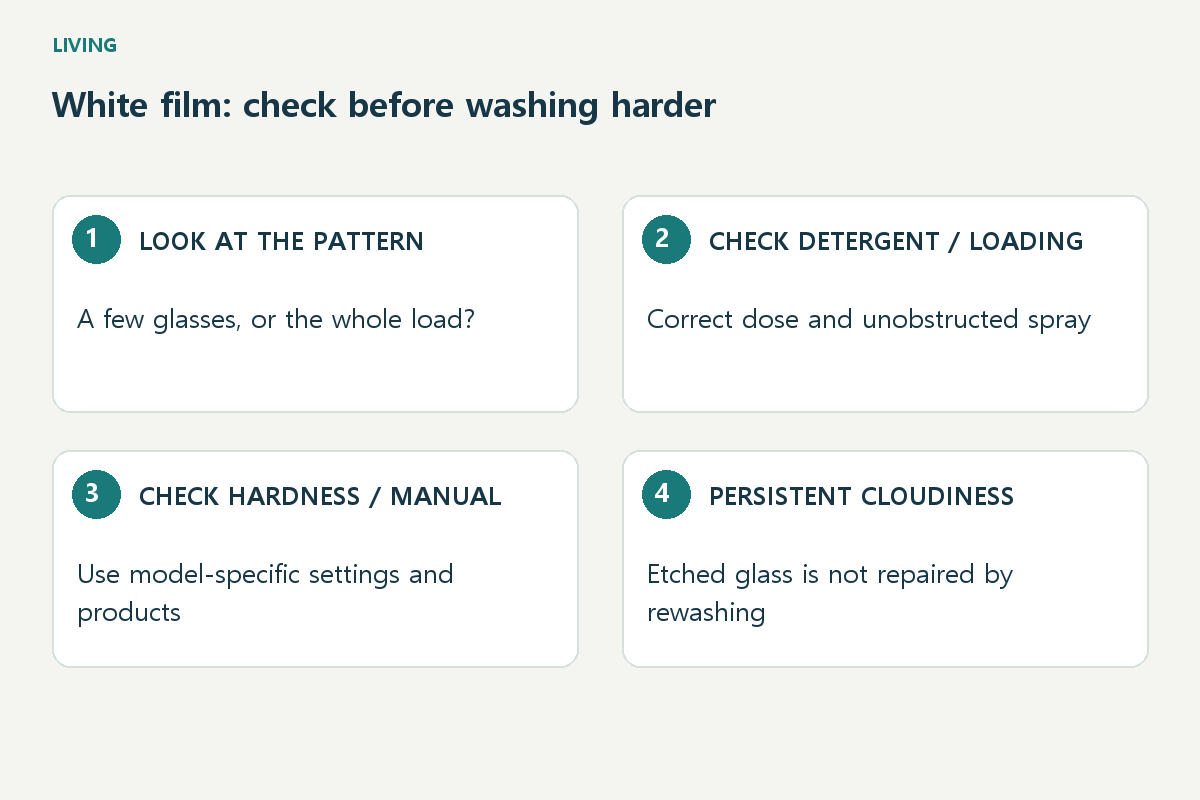
Look at the pattern before changing settings
Are only a few glasses affected, or are there marks on plates and the machine interior too? Comparing items from the same load helps narrow the question. Photograph the marks and note whether gentle hand washing removes them; do not scrape the glass with an abrasive tool.
Samsung identifies hard water and excess detergent among the causes of white residue. Whirlpool distinguishes removable film from etching, which is permanent damage to the glass surface. Samsung white-residue guidance Whirlpool film and etching guidance
Use symptoms as clues, not a diagnosis
| Pattern | First check |
|---|---|
| Film on several items and inside the machine | Water hardness and detergent amount |
| Poor results in one loading position | Blocked spray or detergent-dispenser clearance |
| A few glasses remain cloudy | Dishwasher suitability and possible surface damage |
| Powder or clumps remain | Dispenser opening, detergent instructions and cycle |
A wipe test cannot identify every cause. Equally, a stubborn mark is not by itself a reason to discard expensive glassware. Follow the appliance maker’s recommended checks and the glassware’s own care instructions, especially for coated or decorative items.
Change one condition at a time
- Detergent: confirm it is for automatic dishwashers and use the instructed amount. Do not substitute hand-dishwashing liquid or split a capsule unless its maker permits it.
- Loading: check that dishes do not block spray-arm movement or the detergent door, following the manual with the appliance off.
- Hardness: obtain the relevant information from your water supplier or the maker’s recommended test. Do not select the maximum setting just because you see white marks.
- Rinse aid and softener: first establish which features your model has, then follow its settings and consumable instructions.
Not every dishwasher has a salt reservoir. Where a built-in softener requires salt, use the specified dishwasher salt rather than table salt. Detergent does not belong in the rinse-aid reservoir. Samsung guidance on rinse aid and dishwasher salt
Turn a water-hardness reading into a model-specific setting
Keep the value, unit, supply area and check date from your water provider together. The examples below use page 1 of the Dutch Bosch SGV4HBX40E quick guide, document 9001679657. This table applies to that model; it is not a universal dishwasher scale.
| Assumed supply hardness | Matching manual range | Setting for this model |
|---|---|---|
| 2.0 mmol/L | 1.9–2.1 mmol/L | H03 |
| 2.5 mmol/L | 2.2–2.9 mmol/L | H04 |
Official Bosch SGV4HBX40E table (PDF, page 1)
The same number in °dH and mmol/L does not mean the same hardness. Match the units before reading the table. If a supplied range such as 2.0–2.5 mmol/L crosses two settings, do not silently select its midpoint: clarify the supply conditions and applicable setting with the water provider and appliance manufacturer.
Keep a useful record of one check
Illustrative entry, not a product test: SGV4HBX40E / confirmed supply value 2.0 mmol/L / previous H04 / matching manual row H03 / adjust only this setting by the manual’s procedure / record the next result with the same glass, similar loading and unchanged detergent dose and programme: ______. Correcting a setting does not establish the cause of the white mark.
If marks started after adding salt and the model has a softener, check the salt-reservoir cap, seal and spilled salt before raising the hardness setting. Follow that model’s instructions for clearing spills. Zanussi’s salt-residue checks
Unsure which compartment is which? Salt, rinse aid and detergent compartments
Example and sources checked on 25 October 2026. Values illustrate reading a table; they are not measured water samples or product-test results.
Follow the cleaning instructions instead of mixing remedies
Do not combine household cleaners into a stronger improvised solution. Use the products and maintenance procedure permitted in your own manual. A cleaning cycle or button sequence described for another model may not apply to yours.
For example, if you used more detergent than instructed, correct that amount on the next comparable load and observe the result. Changing detergent, rinse aid, temperature and loading all at once makes it harder to learn which change mattered.
Send support the information they can use
Record model / detergent type and amount / cycle / affected items / hardness or softener setting / before-and-after photographs. If the problem is confirmed as etching, stronger washing will not rebuild the glass surface. The useful next step is to correct the conditions so replacement glasses do not develop the same problem.
This process does not certify that a particular mark is harmless or identify a machine fault remotely. It gives you a controlled way to check routine causes and a clear record if manufacturer support is needed.
Related guide
Before Buying an Appliance: Size, Energy Labels, and Manuals
Sources checked: 20 September 2026. Prepared and reviewed with AI assistance using official information. This is an informational guide, not a first-hand product test or site visit.