In vacuum specifications, Pa describes pressure, while air watts (AW) describe air power using pressure and airflow together. There is no fixed conversion such as “100 Pa equals 1 AW.” Before comparing different units, check airflow, test conditions, and the brush and mode you will actually use.
Check what “suction” means on the label
| Label | What it describes | What else to check |
|---|---|---|
| Pa or kPa | Pressure difference | Measurement position and operating condition |
| AW, or suction air power in W | Power involving pressure and airflow | Test basis, mode, and attached tools |
| Electrical input in W | Electricity drawn | Whether it refers to the vacuum, charger, or emptying station |
Look at the description next to W. “500 W electrical input” and “200 W suction air power” are different measurements, even though both use watts.
For an example, look at the specifications for the Korean market: Samsung's Bespoke Slim 150 W, model VS15A680AFN, states that maximum air power is calculated from airflow in L/s multiplied by vacuum pressure in kPa. Its footnote identifies an in-house test in handheld configuration, without a brush, at MAX mode, under IEC 62885-2 section 5.8. Samsung Korea VS15A680AFN test footnote
This example shows what to look for in the notes beneath a large headline number. We are not recommending the product, and we have not independently repeated the test or confirmed that similarly named models in other regions have the same specifications.
Higher pressure can still mean lower air power
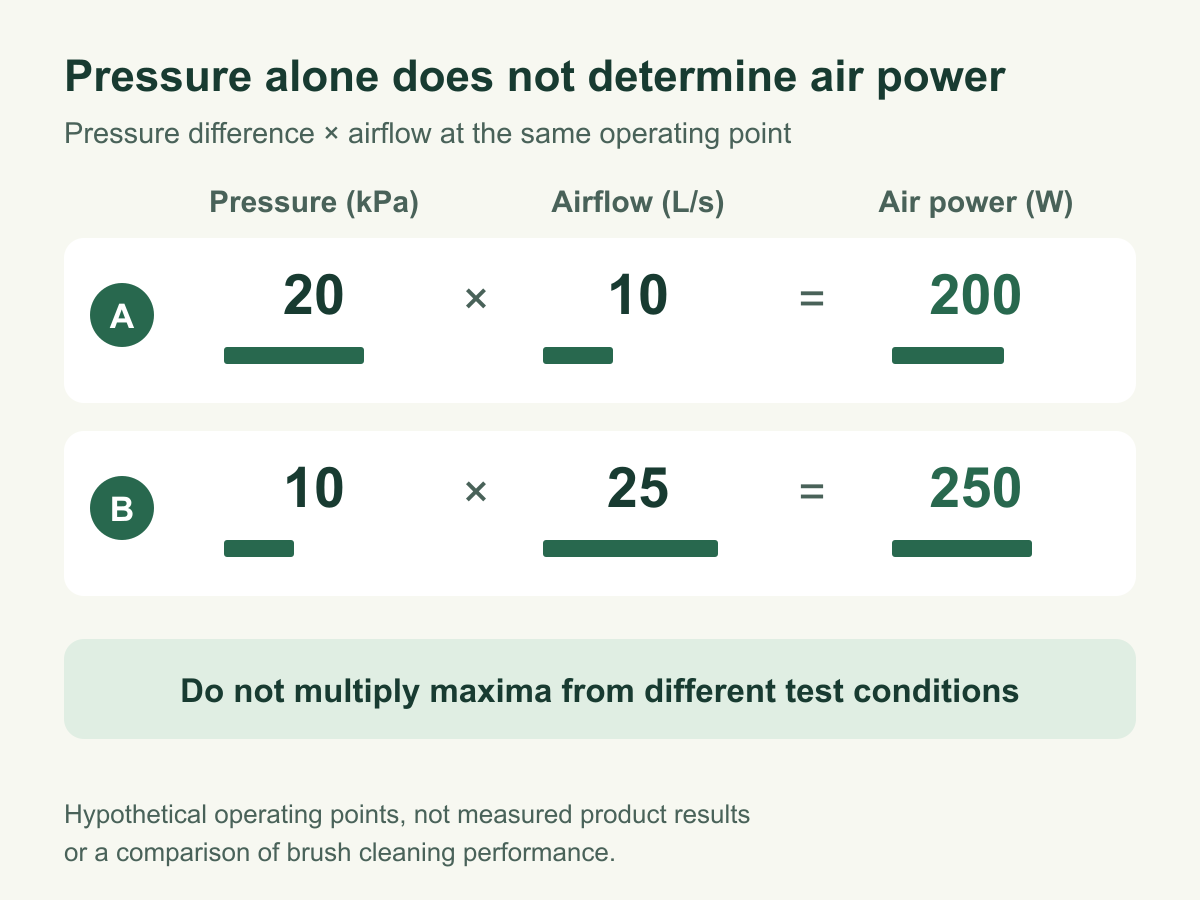
Imagine two different test conditions. The figures below are made up to explain pressure and air power; they are not measurements of real products.
| Hypothetical point | Pressure difference | Airflow at that point | Calculated air power |
|---|---|---|---|
| A | 20 kPa | 10 L/s | 200 W |
| B | 10 kPa | 25 L/s | 250 W |
- A:
20 kPa × 10 L/s = 200 W - B:
10 kPa × 25 L/s = 250 W
A's pressure is twice B's, but B's calculated air power is higher. Airflow is necessary to calculate that result. Also note that 20 kPa equals 20,000 Pa: you must align units before inserting a pressure stated in Pa into a formula written for kPa.
For the calculation to work, the pressure and airflow must come from the same operating point. Do not multiply a listing's maximum pressure by a maximum airflow measured in a different condition and treat the result as its official maximum air-power rating. You need the product's actual test method and results to confirm that rating.
The question “Which is stronger, 30,000 Pa or 200 AW?” cannot be answered from those two figures alone. An online calculator given only pressure cannot supply a verified air-watt rating for the product.
Does a higher AW rating mean a cleaner floor?
Air power is useful, but it does not describe the whole cleaning result. The public explanation of ASTM F558-21 distinguishes maximum potential air power under its test conditions from air power during cleaning, when tools and surfaces affect the result. ASTM F558-21, public Significance and Use
If you need a vacuum for hard flooring, comparing maximum body-only figures leaves out the floor head you will use. For carpets or hair, look separately for a test or demonstration involving the relevant surface and debris. If you cannot find a relevant test or demonstration, mark the cleaning result as unconfirmed instead of guessing a score.
Also avoid directly ranking a robot vacuum's Pa against a handheld stick vacuum's AW. First decide which kind of vacuum suits the cleaning you need to do, then compare models of that kind.
Turn the specification sheet into five practical checks
| Comparison item | What to record | If information is missing |
|---|---|---|
| Suction figure | Value, unit, test basis, and measurement location | Do not rank by number size alone |
| Parts you will use | Exact extension tube and brush | Do not apply a body-only rating automatically |
| Normal operation | Intended mode and runtime in that mode | Do not pair maximum suction with longest runtime |
| Your floor | Hard floor, rug, or carpet; main debris | Do not expect the same result as a test on a different floor |
| Care and ownership costs | Filter, brush, and battery parts; replacement and local supply | Resolve required supplies before ordering |
If a listing gives suction at the highest setting and runtime at the lowest, ask whether you can get both figures at the same time. Check whether runtime was measured with the brush attached. These questions help you compare the same conditions; they do not tell you whether an entire brand is good or bad.
If a store permits a demonstration, attach the tube and brush you expect to use. Try pushing the vacuum and changing direction on the floor. Moving the vacuum as you would at home tells you more about your working position than briefly lifting the body. A short demonstration cannot establish battery lifespan or long-term durability.
Could caring for your current vacuum solve the problem?
If your current vacuum has recently become difficult to use, find the dust-bin, filter, and brush instructions for its exact model. Separate washable parts from parts that need replacement. Use official support instead of trying water cleaning or disassembly that the manual does not permit.
If it already cleans the floors you need and its runtime and weight are manageable, a larger Pa or AW figure alone is not a reason to replace it. If a necessary brush is unavailable or runtime does not meet your task, start with candidates that address those specific limitations.
Compare purchase price with required extra heads, availability of a replaceable battery, supply costs, and delivery. Leave “three-year ownership cost” unconfirmed if you do not yet know replacement prices or when parts will need changing. Our appliance buying checklist explains the model and supply information to gather.
A short question to send the seller
If the different units are making comparison difficult, ask the seller:
Which mode, measurement position, and test method produced this model's suction figure? Are performance and runtime data available with the floor head I will use? Do you publish an official air-power rating as well as pressure in Pa?
If no answer is available, leave the missing rating unconfirmed. Do not fill the gap by converting pressure alone into AW. Figures for the brush and mode you will actually use make it easier to choose a vacuum that fits your needs.
Sources checked: September 8, 2026. AI assisted drafting and English localization from our Korean article. We checked the manufacturer's footnote and ASTM's public scope explanation, not the paid standard in full. Hypothetical calculations are not product test results; no hands-on performance test was performed.