To work out how many organizers fit, compare the drawer's usable inside dimensions with each organizer's largest outside dimensions. Simply dividing the widths can overlook raised rims, parts that stick out, and the room you need to lift a box out. Try the calculation with the organizers turned the other way, too.
Keep three measurements separate
| Measurement | Why you need it |
|---|---|
| Drawer's usable internal dimensions | Find how much space you can use |
| Organizer's maximum external dimensions | Check fit, including the rim |
| Organizer's usable internal dimensions | Check whether the contents fit inside it |
For an example, look at the specifications for the Korean market: IKEA's NOJIG organizer, article 804.681.07, lists width 20 cm, depth 25 cm, and height 10 cm. The table does not list the width and depth of the inside base. So those figures alone cannot tell you whether a 25 cm-long object will fit inside. IKEA Korea NOJIG 804.681.07 dimensions
Ask for internal dimensions when the contents would be a close fit. This product is only an example of reading a dimension table; it is not the organizer used in the fictional layout below. Check the precise regional article number and option before using a specification for your own purchase.
Measure the front, middle, and back of the drawer
The drawer front's outside width is not its internal width. Measure width and depth where the organizers will sit. For height, measure the space available when the drawer is closed, so neither the organizer nor its contents touch the structure above.
Look for screw heads, internal rails, sloping sides, and other obstructions at the organizer's intended height. If the back is narrower than the front, use the narrowest measurement where the organizer will sit.
Write down:
- Usable internal width, W.
- Usable internal depth, D.
- Available height with the drawer closed, H.
- Space to leave at the left, right, front, and back.
- Gaps between neighboring organizers.
Use one unit throughout. Writing every measurement in millimeters avoids mixing centimeters and millimeters; 11 cm and 110 mm are the same length. The gaps in this example will not suit every drawer. Allow for small measuring errors and leave enough room to take the boxes out in the way you need.
Why four across can turn out to be three
These are invented dimensions, not measurements of an actual drawer or product.
| Item | Assumed dimensions |
|---|---|
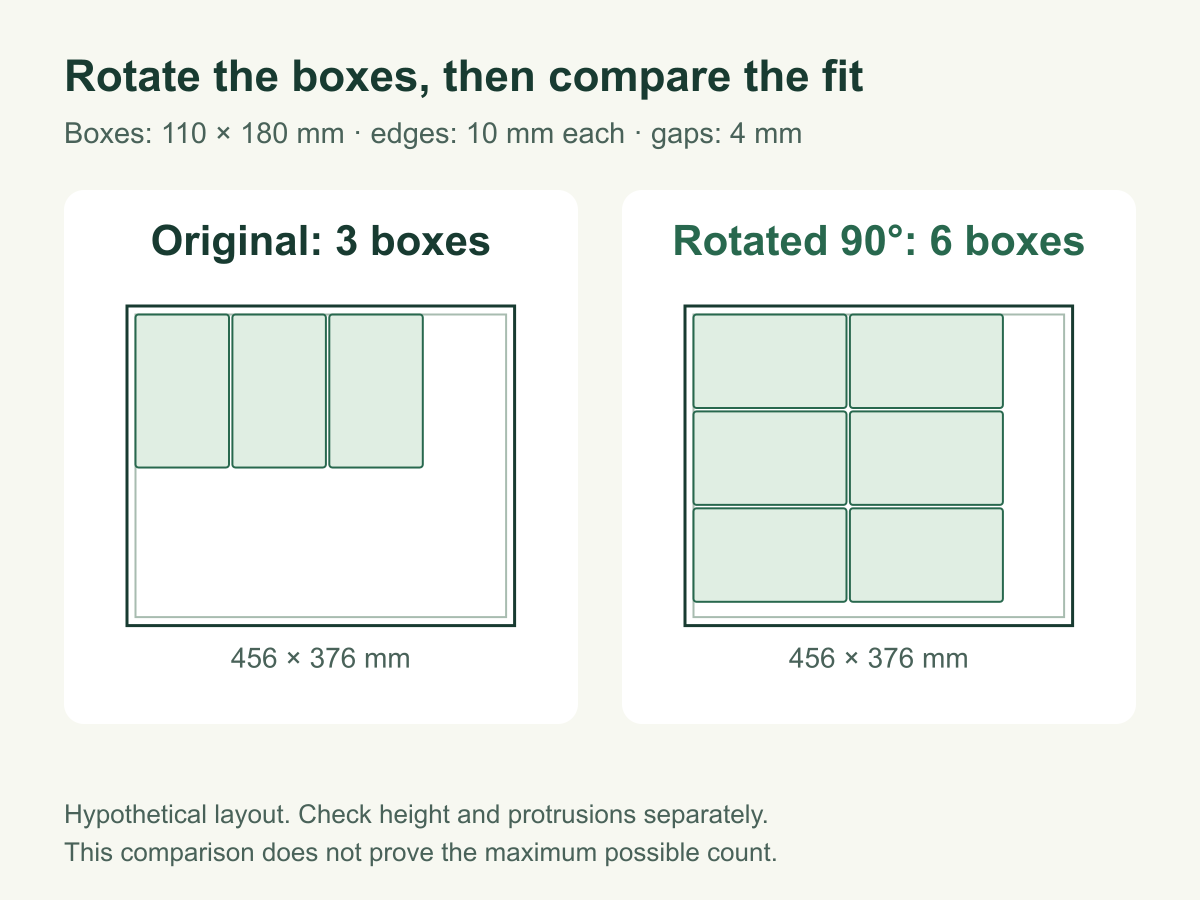
| Usable drawer interior | 456 mm wide × 376 mm deep × 72 mm high |
| Maximum size of one organizer | 110 mm wide × 180 mm deep × 60 mm high |
| Clearance at each of the four drawer edges | 10 mm |
| Gap between organizers | 4 mm |
The simple division 456 ÷ 110 suggests four across. Include three gaps and both edge clearances:
4 × 110 + 3 × 4 + 20 = 472 mm
That exceeds the drawer's 456 mm width. Four across cannot fit under these assumptions. Three across need 330 + 8 + 20 = 358 mm, so they fit within the width.
Now check whether two rows fit front to back:
2 × 180 + 4 + 20 = 384 mm
That exceeds the 376 mm depth. In this orientation, the layout is three across × one row = three organizers. Fitting in only one direction is not enough.
Rotate the same organizers to fit six
Turn every organizer through 90 degrees so its 180 mm side runs across the drawer. Keep the same edge clearances and gaps.
- Two across:
2 × 180 + 4 + 20 = 384 mm - Three rows:
3 × 110 + 2 × 4 + 20 = 358 mm
Both totals fit within the drawer's dimensions. This orientation allows two across × three rows = six organizers. It leaves an additional 72 mm in width and 18 mm in depth, beyond the edge clearances already included.
Other layouts may hold more. You could mix sizes or turn only some of the boxes. Checking two layouts with all the boxes facing the same way is just an easy place to start.
For equal rectangular organizers placed in one orientation with uniform gaps, use:
Count across = max(0, floor[(W − E + g) ÷ (w + g)])
Here W is drawer width, E is the sum of left and right edge clearances, g is the gap, and w is the organizer's maximum width. “Floor” means round down to a whole number; “max(0, …)” prevents a negative count. Use positive widths and nonnegative gaps and clearances. If the required edge clearances alone exceed W, the arrangement is not possible.
Apply the same method in the depth direction. Include projecting handles and rims in the maximum outside dimensions.
A layout can fit the base and still stop the drawer closing
The example organizer is 60 mm high and the available height is 72 mm. If its contents extend above the rim, check their height too. For a lidded box, measure with the lid and handle in the position in which it will be used.
Rounded corners or a wide upper rim may differ from a simple paper rectangle. A fabric organizer may change shape once you fill it, so check more than its empty dimensions before deciding it will fit.
Before ordering, try a paper layout or similar empty boxes you already have. Paper shows how much of the drawer base the boxes would cover. You still need to check their height and the shape of the rims. If the fit is close, checking one actual organizer can be more useful than ordering several multipacks immediately.
When fewer organizers work better
Six may fit mathematically, but you do not need six if the contents belong in three groups. An open section or a divider may suit a long tool better than another small box. Reconsider the layout if reaching an everyday item requires lifting other containers first.
If you have not decided what belongs in the drawer, start with organizing before buying more storage. This calculation is the next step, after deciding what to keep and which divisions you need.
Before ordering, check usable internal space, maximum external size, height, gaps, and rotation. A little empty space is fine. What matters is being able to take things out and put them back easily.
Sources checked: September 8, 2026. AI assisted drafting and English localization from our Korean article. We created the layout using made-up dimensions and included a separate example of a manufacturer's size listing. It is not a fit test of an actual drawer and organizer.