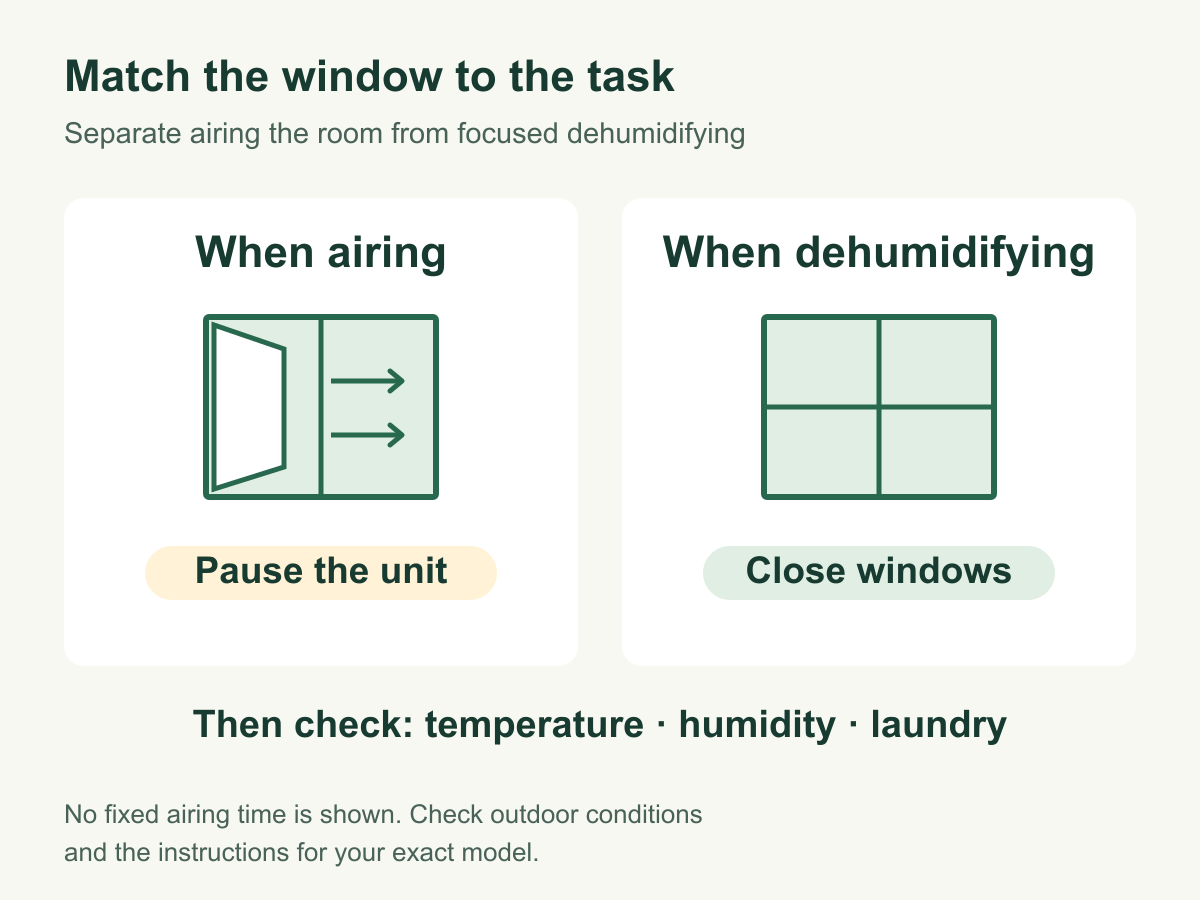
Keep the windows closed while a dehumidifier is drying laundry indoors, but make time for ventilation too. Removing moisture does not bring fresh air into the room. Ventilate when needed, then close the windows before running the dehumidifier. In a studio apartment, think about when you will be in the room and how warm it gets, as well as when you need the washing to be dry.
When does the advice to close windows apply?
US ENERGY STAR advises closing doors and windows while the dehumidifier runs to help it work efficiently. It also notes that the area around the unit can become warmer. This does not mean permanently sealing a home. ENERGY STAR dehumidifier guidance
Bringing in clean outdoor air and reducing sources of pollution are also part of caring for indoor air. A lower humidity reading does not mean the room has been ventilated. US EPA indoor air guidance
Try setting aside separate times to air the room and run the dehumidifier. The table below offers a way to plan that routine; it is an editorial suggestion, not the result of testing a particular appliance.
| Situation | First action | What to check next |
|---|---|---|
| You have ventilated and are about to hang washing | Close the windows and operate the unit as its manual permits | Temperature, humidity, and the laundry |
| Ventilation becomes necessary during operation | Pause dehumidifying and ventilate with outdoor conditions in mind | Whether to resume after closing the windows |
| Humidity falls but the room becomes uncomfortably warm | Change the operating time or drying location | Whether you can dry laundry when no one is using the room |
| One wall stays wet even on days without washing | Record where and when it happens; ask the person responsible for the property to investigate | Whether buying an appliance addresses the actual problem |
There is no single window-opening duration that fits every home. Outdoor air, window layout, and household routines differ. Avoid treating a fixed number of minutes as proof that ventilation is complete.
Do not decide from relative humidity alone
Relative humidity depends on temperature, so its reading can change without a change in water-vapor amount. A lower percentage outdoors does not, by itself, tell you that opening a window will reduce the moisture indoors. ENERGY STAR on relative humidity
To compare your notes from one day to the next, use the same temperature-and-humidity meter in the same place. Choose a location that helps you observe the room, rather than the air directly at the dehumidifier outlet, and follow both devices' placement instructions.
Try the following log for a few loads. Different weather and different amounts of laundry prevent a strict product-performance comparison. What you are looking for is when drying laundry makes your day less comfortable or convenient.
| When to record | What to note |
|---|---|
| Before hanging the washing | Room temperature and humidity; whether you ventilated |
| When starting the unit | Time, operating mode, and the types of clothes |
| During drying | Temperature and humidity; whether a full tank stopped the unit |
| When taking the washing down | Finish time; any damp waistbands, thick seams, or other slow-drying areas |
If daytime use is manageable but heat and noise disturb sleep, changing the washing schedule may be more useful than buying a larger unit.
Extraction capacity and tank capacity are different
Extraction capacity tells you how much water a dehumidifier removes over a stated period under specified test conditions. Tank capacity tells you how much water it can hold. A bigger tank does not, by itself, mean faster moisture removal. ENERGY STAR buying guidance
Suppose a hypothetical listing says “12 L per day; 3 L tank.” The 3 L figure is storage capacity. You cannot conclude that the tank will always need emptying every six hours: actual moisture input and operation are unknown. These invented figures are not recommended specifications.
For each model you are considering, note these four things:
- Extraction capacity, its unit, and the test temperature and humidity.
- Tank size and whether full-tank shutoff and alerts are actually included.
- Permitted operating temperatures compared with the room you will use.
- Space to remove, empty, and replace the tank.
Keep inlets and outlets clear. Keep drips away from the appliance, socket, and electrical connections; follow the manufacturer's electrical-safety instructions. ENERGY STAR placement and electrical precautions
For continuous drainage, check the exact model's installation requirements before assuming that adding a hose is enough. Use the model sold for your place of use; do not infer compatibility from a similar name in another country. Our appliance buying checklist covers manuals, space, connections, and supplies.
Estimate electricity use from power and running time
Use:
Average power (W) ÷ 1,000 × operating time (h)
Assume an average of 300 W, four hours a day, on 20 days in a month:
300 ÷ 1,000 × 4 × 20 = 24 kWh
At two hours a day, the same example gives 12 kWh; at six hours, 36 kWh. These are explanatory calculations, not measured appliance results.
If you insert the rated power from a specification sheet, you are assuming that power is maintained throughout the period. A unit that cycles or changes output may have a different actual average.
The result is electricity consumption, not the extra amount on your bill. To estimate cost, check your household's applicable tariff and billing conditions. Do not substitute an assumed local rate or currency conversion for that information.
When a purchase can wait
If a different washing interval or drying time lets clothes dry when needed, and the usual room conditions are comfortable, a new dehumidifier may be unnecessary. If your existing unit dries the laundry and emptying the tank is the only inconvenience, first look at where and how you handle the tank.
If indoor drying is frequent and changes to ventilation and placement still leave clothes damp when needed, use your log to shortlist suitable models. Wait to buy if your room cannot meet the space or operating-temperature requirements in the manual.
Start by looking at your current routine: are the windows open the whole time the dehumidifier runs, and do you air the room separately when needed? Then make notes while drying one load. They will help you work out what you need before comparing capacity figures.
Sources checked: September 8, 2026. AI assisted drafting and English localization from our Korean article. This guide uses official consumer guidance and original planning examples; it is not a hands-on review or measured drying test.