Start with the room where you will use an air purifier, rather than the total floor area of your home. Clean air delivery rate, or CADR, helps you compare how much particle-filtered air a purifier delivers. To make sense of the figure, check the units and the conditions in which it was measured. For a bedroom, check what it can do at a fan speed you are comfortable leaving on at night.
Is CADR 150 greater than CADR 3.0?
You cannot tell without the units. Listings may use cubic meters per hour (m³/h), cubic meters per minute (m³/min), or cubic feet per minute (cfm). First, check whether the figure is per hour or per minute.
Suppose fictional product A is rated at 150 m³/h and B at 3.0 m³/min. Convert B to the same hourly unit:
3.0 m³/min × 60 min/h = 180 m³/h
B has the larger number if both figures describe the same kind of CADR under comparable test conditions. If a listing says only “CADR 300,” ask the manufacturer for the unit before comparing it. A cfm value also cannot be treated as the same numerical value in m³/h.
The US EPA advises choosing sufficient CADR for the room and explains that the rating concerns particles. It is not an all-purpose score for odors, gases, or every indoor pollution problem. EPA guide to air cleaners
Write down floor area and air volume separately
Consider a hypothetical room 3 m wide, 4 m long, and 2.4 m high.
- Floor area:
3 × 4 = 12 m² - Simplified air volume:
12 × 2.4 = 28.8 m³
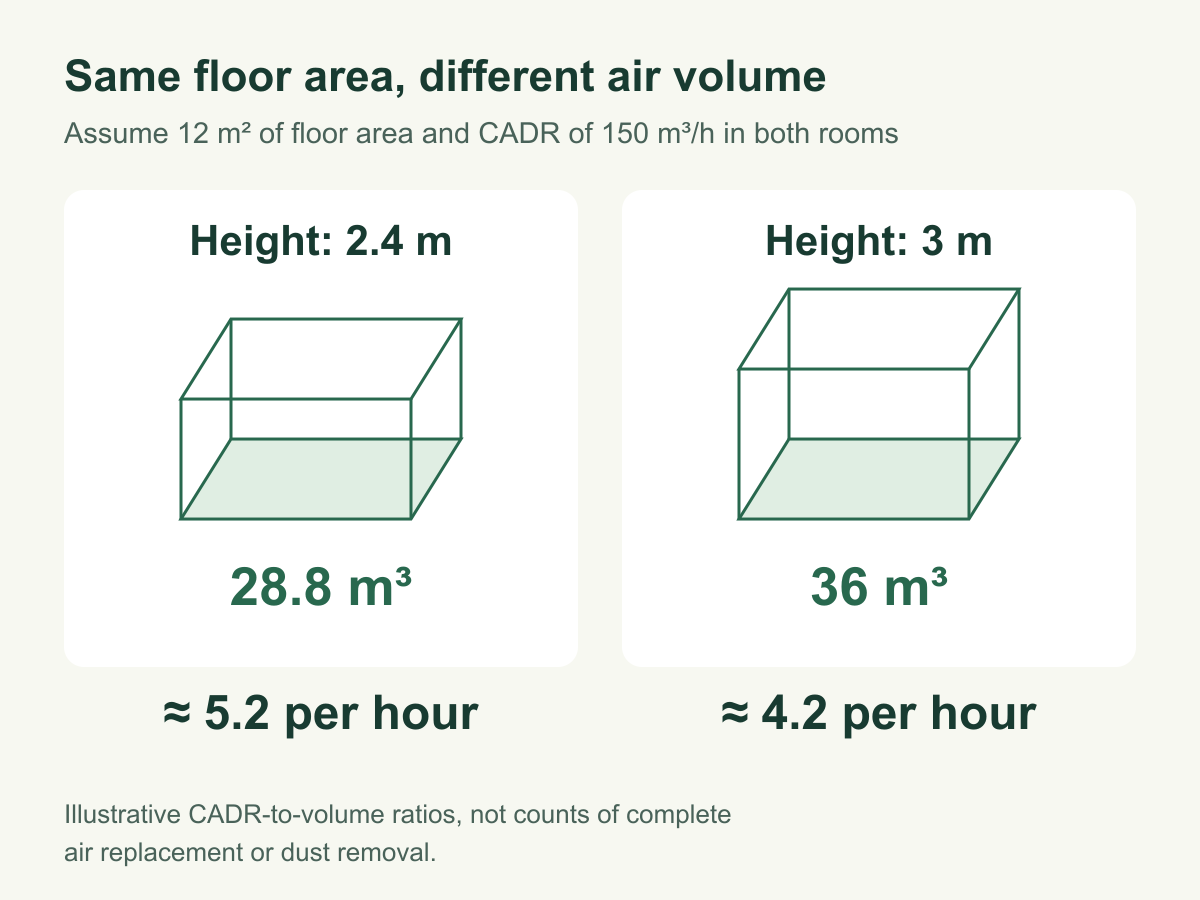
For a CADR of 150 m³/h, 150 ÷ 28.8 ≈ 5.2 per hour. The calculated clean-air delivery is equivalent to about 5.2 room volumes in an hour. It does not mean all the room air is perfectly replaced 5.2 times, or that every particle disappears after a set period.
This example helps explain the units; it does not mean every room needs 5.2 per hour. The simple division leaves out open doors, furniture, uneven air mixing, and particles that keep entering the air.
Now imagine the same floor area with a 3 m ceiling. Volume becomes 36 m³, so 150 ÷ 36 ≈ 4.2 per hour. This shows why equal floor areas need not contain equal air volumes. The EPA's own sizing table also states its ceiling-height assumption. EPA room-sizing table
Keep one unit system throughout your calculation. If your room measurements are in feet, either use compatible cubic-foot units or convert all the measurements before using the metric example.
For a bedroom, compare the speed you will actually use
CADR is typically measured at the highest fan speed, and lower speeds filter less air. Do not combine maximum CADR with minimum sleep-mode noise as though they occur together. EPA on CADR and fan speed
Ask the seller:
Which fan speed was used for the stated CADR? Are noise and air-delivery data available for the setting I would use at night?
If you cannot find lower-speed figures, note “maximum-speed data only.” Missing figures do not mean the purifier is a poor choice, but you cannot assume it delivers the same performance at a quieter setting. If possible, listen to a display model at the speed you would use. Bear in mind that it may sound different in a quiet bedroom.
Compare candidates for the same room
| Item | What to record | Reason to pause |
|---|---|---|
| Intended space | Floor area, ceiling height, and usual door position | Only the whole-home area is known |
| Air delivery | CADR value, unit, particle type, and test basis | Unit or rating scope is missing |
| Normal operation | Intended fan setting and data for that setting | Maximum performance is paired with minimum noise |
| Placement | Inlet and outlet directions; manual clearances | The available position blocks airflow |
| Maintenance | Exact filter parts, quantities, replacement guidance, and local supply | Compatible filters cannot be identified |
Note which regional rating system each figure comes from. For example, if a Korean-market model lists a certified service area, record its stated standard alongside the value. Do not use a US reference table to calculate your own Korean certified area, or combine different rating systems into a single score. Check the actual model and instructions sold in your region.
Portable air cleaners are intended for a room or area. A large coverage figure for the whole home does not mean the purifier will work equally well in a bedroom with the door closed. EPA on the scope of portable air cleaners
Count replacement sets before comparing filter costs
This example uses made-up prices in Korean won so you can follow the calculation. These are not current offers or estimates of what you would pay in your country.
Assume the appliance costs KRW 200,000 and a full filter set costs KRW 50,000. The first set is included. Over 36 months, assume replacement every 12 months and exclude a replacement at the very end of month 36. You buy two additional sets, at months 12 and 24:
KRW 200,000 + KRW 50,000 × 2 = KRW 300,000
If the assumed interval is six months, replacements occur at months 6, 12, 18, 24, and 30: five sets. The total becomes KRW 450,000.
Neither interval is a product recommendation. Electricity, delivery, and repairs are excluded. Use the same period and include the same costs when comparing models. Then substitute prices you have checked in your own currency; you do not need an exchange rate to use the method.
Also distinguish the price of one filter from the total needed for one complete replacement. Our appliance buying checklist explains how to identify supplies for the exact model.
What to check before replacing an existing purifier
First check whether its placement follows the manual, whether its filters have been maintained as instructed, and which speed you actually leave running in the intended room. Those details help you see what a larger model might actually change.
For a new purchase, write down three things today: room dimensions, CADR units, and intended fan speed. With those details, you can choose more confidently than by relying on labels such as “large-room” or “bedroom” alone.
Sources checked: September 8, 2026. AI assisted drafting and English localization from our Korean article. EPA guidance is general consumer information. Room and cost examples use hypothetical conditions; no individual purifier was tested.