Curtain sizing starts with three different widths: the track you want to cover, the width of each panel sold, and the finished width after pleating. Keep them separate. Applying a fullness multiplier to an already pleated finished width can make you order too much fabric.

Measure the track you will actually use
For an existing pole or track, measure the usable coverage rather than decorative finials. For a new installation, first decide how far the treatment will extend beyond the window. IKEA’s measuring guidance accounts for the installation and hanging position. IKEA curtain measurement guide
The window opening, rail length and intended coverage may be three different measurements. A cupboard or uneven wall space can limit one side. Also consider where open curtains will stack and whether they will obstruct a door or handle.
Ask what the advertised width means
| Width description | What it describes | Question to ask |
|---|---|---|
| Flat fabric width | The panel with fullness spread out | Should I apply a fullness multiplier? |
| Finished pleated width | Coverage after the pleats are formed | How many finished panels cover my track? |
| Set width | The combined width of multiple panels | Is this per panel or for the whole pair? |
A listing that says “140 × 230 cm” is incomplete for your calculation until you know whether 140 cm is one panel or a pair, and whether it is flat or finished width. Do not infer the answer from the product photograph.
A worked example for a 240 cm track
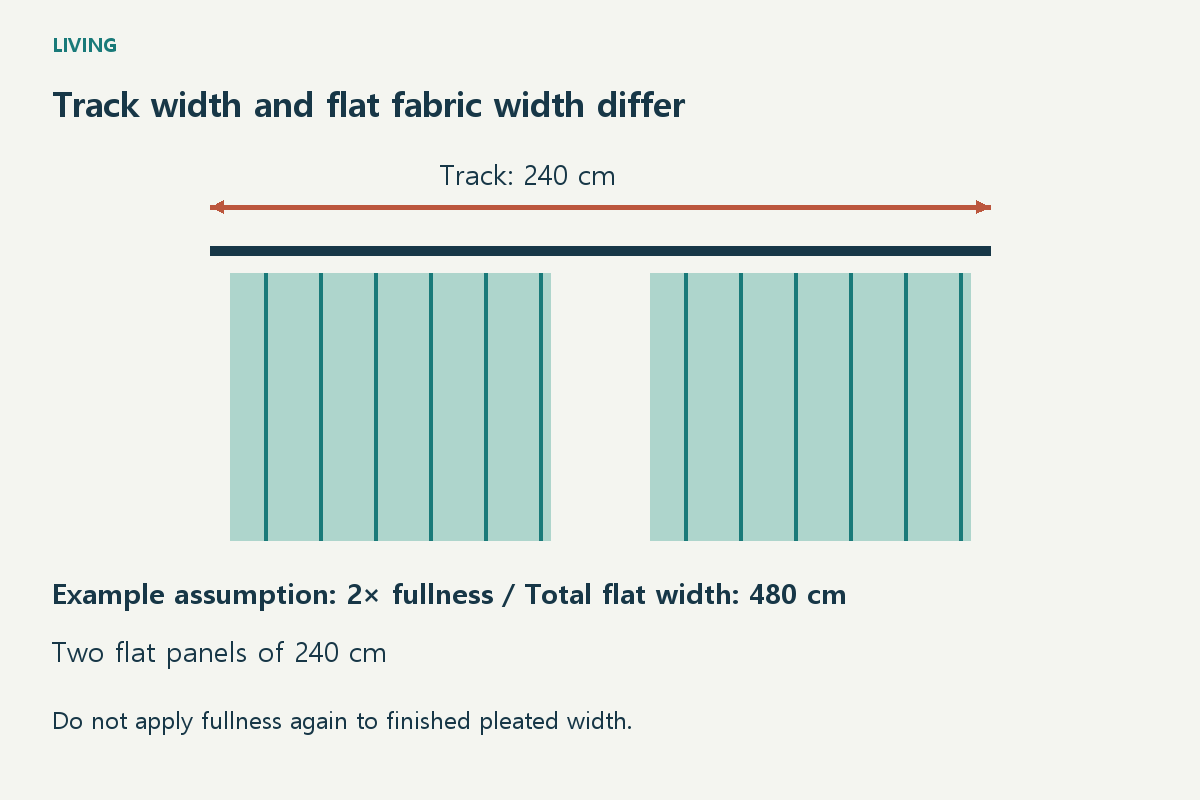
Suppose the seller recommends flat fabric width equal to twice the track width. A 240 cm track then needs 480 cm in total. For two made-to-measure flat panels, that would be 240 cm per panel. The multiplier of two is an assumption for this example, not a rule for every fabric and heading.
If ready-made panels are each 140 cm flat, 480 ÷ 140 is about 3.43. Four panels meet the assumed target; rounding down to three leaves only 420 cm. Before ordering four, consider the joins, opening arrangement and whether your track and fittings support that layout.
Now change the listing: if each panel is 120 cm wide after pleating, two provide 240 cm of finished coverage. Multiplying by two again would count the fullness twice. Check any centre overlap or side-return allowance with the supplier rather than adding it without knowing their sizing method.
Measure drop from the correct starting point
With hooks, the top of the fabric may not sit level with the rail or pole. Use the hook reference point specified by the seller and measure to your intended hem position. Eyelet headings need their own reference; one measurement taken from the top of a pole will not suit every heading style.
Measure at the left, centre and right to reveal an uneven floor. Decide whether the curtain should clear the floor or touch it, then check the maker’s washing and shrinkage advice. Avoid adding an arbitrary few centimetres for shrinkage without knowing how that product is sized.
Send the seller a useful measurement note
Try: “My usable track width is ___ cm. The distance from your specified hanging point to my intended hem is ___ cm. Is your panel width flat or finished after pleating, and is it per panel or per pair? How many panels would you supply for this coverage?” A photograph of the tape position helps resolve misunderstandings before an order is cut.
Related guide
Will the Furniture Fit? Measure the Room and the Delivery Route
Sources checked: 20 September 2026. Prepared and reviewed with AI assistance using official information. This is an informational guide, not a first-hand product test or site visit.