To check robot-vacuum threshold compatibility, record more than one height. Measure both directions and describe the edge shape and approach space. A maximum climbing figure on a product page should not be read as a promise for every doorway in your home.

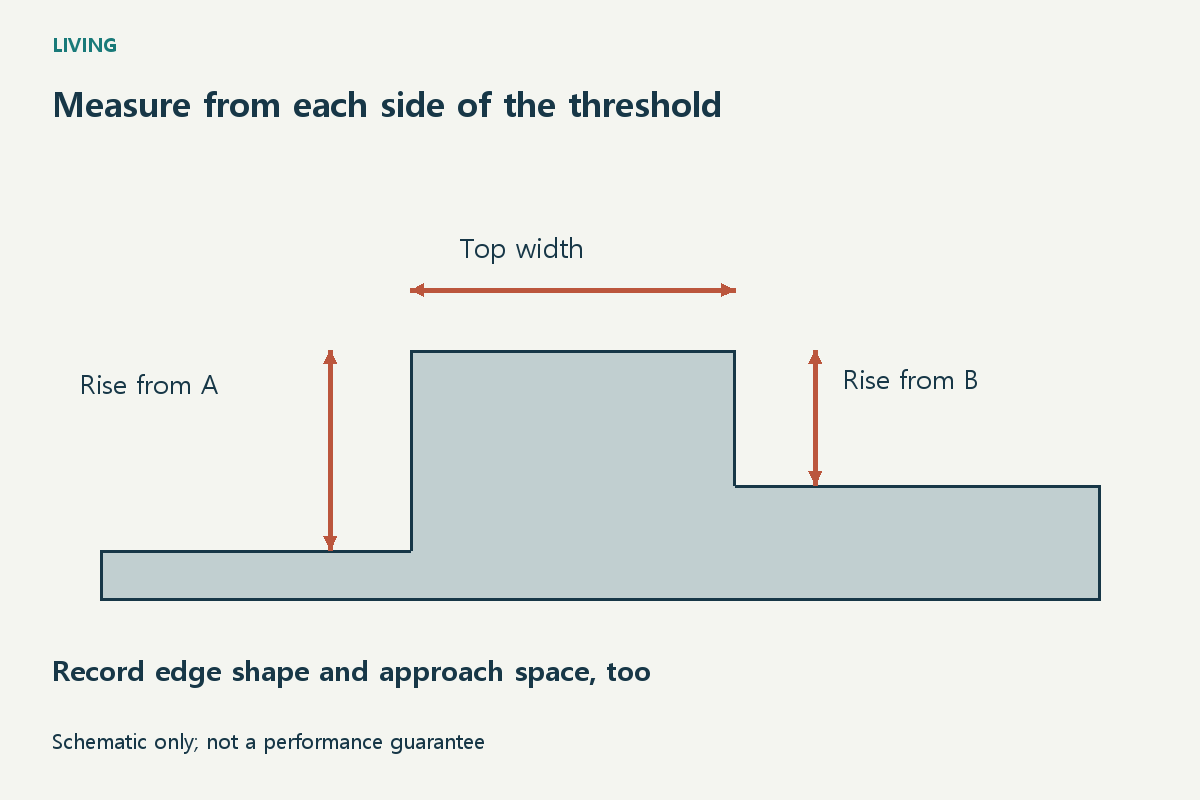
Measure vertically from the starting floor
Hold a ruler vertically from the floor the robot will approach on to the highest point of the threshold. If the floor on the other side is at a different level, the return climb is different too. Measure both sides; a tape held at an angle can overstate the vertical rise.
If a rug crosses the threshold, record the bare threshold and the covered arrangement separately. A soft, compressible mat and a solid step are not the same physical setup. Photograph how the doorway is normally used rather than temporarily clearing everything for the picture.
Read the number with the model’s conditions
Manufacturers provide obstacle-crossing guidance, as in iRobot’s threshold help page and Vorwerk’s VR7 manual. Check the exact model and market version instead of transferring one model’s figure to all robot vacuums. iRobot threshold guidance Vorwerk VR7 manual
If your measurement is close to an advertised maximum, send the seller the actual setup rather than treating the number as automatic approval. Compare the obstacle shape in a demonstration with your doorway. This guide is a measurement method, not a report of testing a particular vacuum in your home.
Comparing “up to 4cm” with a 35mm doorway
Roborock’s official German FAQ distinguishes Qrevo Curv from Qrevo Curv S5X. This example compares the conditions listed in that official German-language document; it does not assume identical conditions for another sales country or product variant. Model conditions checked: 26 October 2026.
| Model | Ordinary/single | Double-layer |
|---|---|---|
| Qrevo Curv | 3cm = 30mm | 4cm = 40mm |
| Qrevo Curv S5X | 2cm = 20mm | No separate figure stated |
The FAQ describes Qrevo Curv S5X as crossing thresholds up to 2cm, without a separate double-layer figure. Do not transfer these figures to CurvX, Curv 2 Pro or another name.
The same total rise can describe different shapes
Hypothetical profile 1 — one 35mm rise: 35mm is 3.5cm. Although 35 is below 40, the double-layer condition does not apply to that single rise. It exceeds the base Qrevo Curv’s stated 30mm ordinary-threshold figure. This compares stated conditions; it is not a test showing that a device failed.
Hypothetical profile 2 — a 20mm rise followed by another 15mm rise in the same travel direction: the cumulative rise is 20+15=35mm. A total below 40mm does not guarantee crossing. Check both edges, the intermediate tread length and the approach direction. The FAQ does not specify a minimum intermediate length; send your measurements and photos to the manufacturer for confirmation.
Here 20+15mm describes two successive rises in one direction. The guide’s A-side and B-side measurements start from opposite floors at the same threshold; do not add those two measurements.
Copyable model and doorway record
| Item | Your record |
|---|---|
| Exact model, sales country and official document | Model ___ / country ___ / URL ___ / check date ___ |
| Profile in one travel direction | Single ___mm or successive ___+___mm / intermediate tread ___mm / edges ___ |
| Height from each floor | A side ___mm / B side ___mm — do not add |
| Use conditions and open questions | Surface/approach space ___ / mop/mode ___ / manufacturer reply or unknown conditions ___ |
Question to send: “The exact model and sales country are ___. Which ordinary/double-layer condition applies to the single rise or successive rises in these photos? Please confirm intermediate-length, mop/mode and return-route restrictions.”
Why a photograph adds useful information
| Record | What to show |
|---|---|
| Edge | Sharp vertical step, rounded edge or ramp |
| Multiple steps | One rise or several rails in succession |
| Width | How far the raised section extends |
| Approach | Whether a door, wall or furniture blocks a straight approach |
| Surface | Firm flooring or a mat that can move or fold |
These details explain how two thresholds with the same height can still present different situations. They do not make a photograph a performance guarantee. Take one side view with the ruler visible and one wider view showing the door in its normal position.
A question to send before ordering
Try: “The rise from side A is ___ mm and from side B is ___ mm. The raised section is ___ mm wide, with the edge shown in these photographs. Do crossing conditions change with the mop attached or in different cleaning modes? Please confirm the applicable limits and trial or return terms.”
Use millimetres consistently to avoid confusing 1.5 cm with 15 mm. List each doorway that matters, not just the highest obstacle. A route also needs to work on the return journey to the dock, so note both directions and any doors that normally remain partly closed.
Keep the first home check supervised
Watch the first crossing in both directions. If the robot becomes stuck or repeatedly spins its wheels, stop rather than forcing more attempts. Follow the manufacturer’s barriers and no-go instructions around stairs or drops; do not cover cliff sensors to make a route work.
If you consider a ramp, check its stability, door clearance and the walking route for people too. An adaptation that helps a vacuum but creates a trip hazard is a poor solution. Where safe adjustment is impractical, include separate cleaning of that room in the buying decision instead of assuming every threshold must be modified.
Related guide
Vacuum Pa vs Air Watts: Why Pressure Alone Cannot Be Converted
Sources checked: 20 September 2026. Prepared and reviewed with AI assistance using official information. This is an informational guide, not a first-hand product test or site visit.